A graduate thesis in spatial practice · Portland State University · 2026
Three subversions of the architectural apparatus.
What capital permits, what design conceals, what labor is forced to absorb. Each layer of the discipline conceals a refusal that has not yet been named. This thesis names three.
A working definition
subversive adj.
“Criticizing something in a clever and indirect way in order to make it weaker or less effective; overturning; flipping from beneath.”
— Britannica
Three layers of the discipline are taken in turn. The thesis does not propose to abolish architecture; it proposes to work underneath it — to displace the categories that produce dispossession while preserving the practice that might still be of use.
Each subversion targets a different operation. Funding reorders the question that capital begins with. Design reorders what the building is asked to do, and for whom. Practice reorders the labor relations through which architecture is produced. Together they describe an immanent critique — a refusal mounted from within rather than from outside the profession.
The three subversions
The architectural apparatus, taken apart in three movements.
Each subversion holds an operative instrument, a worked example, and an open question. Read them in sequence: each presupposes the one before.
01
Subversion of Funding
Neighborhood Triage
The speculative pro forma is displaced by a diagnostic instrument. Eight domains, forty-eight indicators, a 1–5 calibration, and an undercount adjustment that names what census data renders invisible. Capital is reordered to follow lacunae rather than yield.
02
Subversion of Design
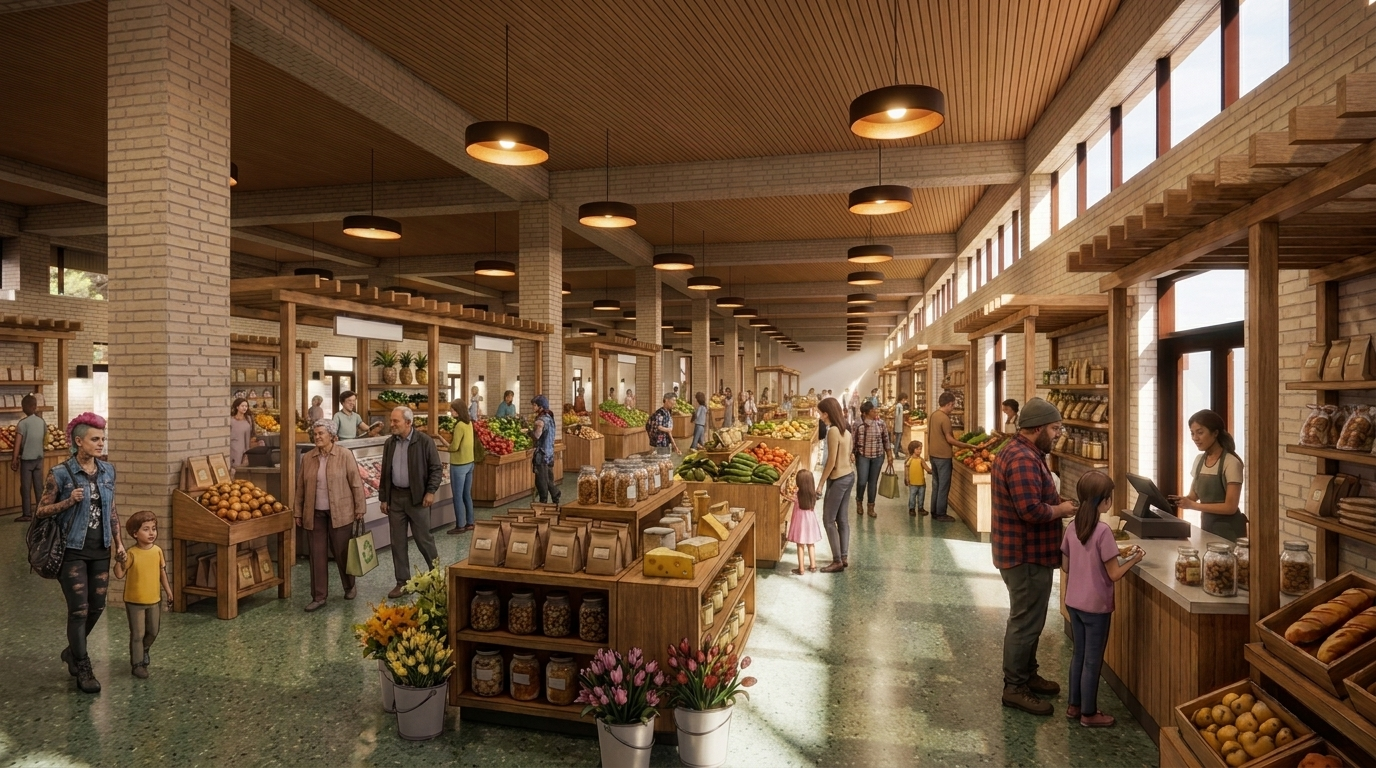
Forthcoming — SE 17th + Schiller
Two floors of public programming carry two floors of public housing, joined by a circulation system staged as social fascia. The instrument that governs scale — a Right-Sizing Density framework — is published as a sibling document. The full design tool is in development.
03
Subversion of Practice
Unionize.
The profession’s labor relations — militarized hierarchy, unpaid internship, gatekept licensure — are not incidental. A radical blueprint for organizing architectural workers, with a sign-up roster for Oregon Architectural Workers United.
Proof of concept
Brooklyn, Portland, Oregon.
A neighborhood produced through serial extraction: a streetcar town deprived of its trolley, a riverfront severed by arterial infrastructure, a rail yard whose particulate emissions intersect the residential grid. The diagnostic was first applied here. The outcome — an adjusted Triage Score of 2.08, baseline edging toward at-risk — produces the program for the building proposed at SE 17th + SE Schiller, a site identified by the Brooklyn Action Committee.
2.08
Adjusted Triage Score
1.50
Food Systems · Critical
1.50
Environmental Justice · Critical
6
Shadow populations enumerated
Position
An immanent critique, openly licensed.
The instruments published here are released under CC BY-SA 4.0. Adapt them, port them, transpose them to other neighborhoods and other professions — on condition that the adaptations carry the same license. The ShareAlike clause is the legal backbone of the political claim: refuse the enclosure of methods that were developed for redistribution.
The thesis is indebted to Making Healthy Places (Botchwey, Dannenberg & Frumkin, 2022), to SERA Architects’ Wellness and Sustainable Project Compasses, and to the Blackfeet Perspective on hierarchy of needs — which inverts Maslow to seat cultural perpetuity at the apex. These are intellectual debts; please cite accordingly.
About
An open framework, openly licensed.
A graduate thesis published under Creative Commons BY-SA 4.0. The framework can be adapted; it cannot be enclosed.
Author + course context
Subversive Architecture is the master’s thesis of Nathalie J. Hutchinson, completed at Portland State University in 2026. The Neighborhood Triage instrument was first developed in ARCH 433/533: Designing for Wellness (Spring 2026); the Right-Sizing Density Toolkit and the Unionize zine were produced in concurrent thesis seminars. The proposed building at SE 17th + SE Schiller is the integrative design output.
The thesis investigates architecture as an instrument of redistribution rather than form-making — specifically, how design can recover the value extracted from neighborhoods by speculative development, and how community-controlled tenure structures (community land trusts, community investment trusts) can be embedded in spatial form rather than appended to it.
Contact
For citation, adaptation, or collaboration questions: nathalie.j.hutchinson@gmail.com.
License
Creative Commons Attribution-ShareAlike 4.0 International (CC BY-SA 4.0)
You are free to:
- Share — copy and redistribute the framework, the spreadsheet, the zine, and the website source in any medium or format
- Adapt — remix, transform, and build upon the material for any purpose, including commercial use
Under the following terms:
- Attribution — appropriate credit, a link to the license, and indication of changes
- ShareAlike — adaptations must be distributed under the same license. The ShareAlike clause is the legal backbone of the political claim: refuse the enclosure of methods developed for redistribution.
Full license text: creativecommons.org/licenses/by-sa/4.0/
Citation
If the framework is deployed in academic work, please cite the method, not only the URL.
Chicago / Turabian (notes & bibliography)
Hutchinson, Nathalie J. “Subversive Architecture: Three Subversions of the Architectural Apparatus.” Master’s thesis artifact, Portland State University, 2026. CC BY-SA 4.0.
APA 7th edition
Hutchinson, N. J. (2026). Subversive Architecture: Three subversions of the architectural apparatus. Portland State University. CC BY-SA 4.0.
For the Brooklyn assessment specifically
Hutchinson, N. J. (2026). Brooklyn Neighborhood Triage Assessment. PSU ARCH 433/533. Adjusted Triage Score: 2.08 (Baseline).
Position
An immanent critique, openly licensed.
The instruments published here are released under CC BY-SA 4.0. Adapt them, port them, transpose them to other neighborhoods and other professions — on condition that the adaptations carry the same license. The ShareAlike clause is the legal backbone of the political claim: refuse the enclosure of methods that were developed for redistribution.
The thesis is indebted to Making Healthy Places (Botchwey, Dannenberg & Frumkin, 2022), to SERA Architects’ Wellness and Sustainable Project Compasses, and to the Blackfeet Perspective on hierarchy of needs — which inverts Maslow to seat cultural perpetuity at the apex. These are intellectual debts; please cite accordingly.