
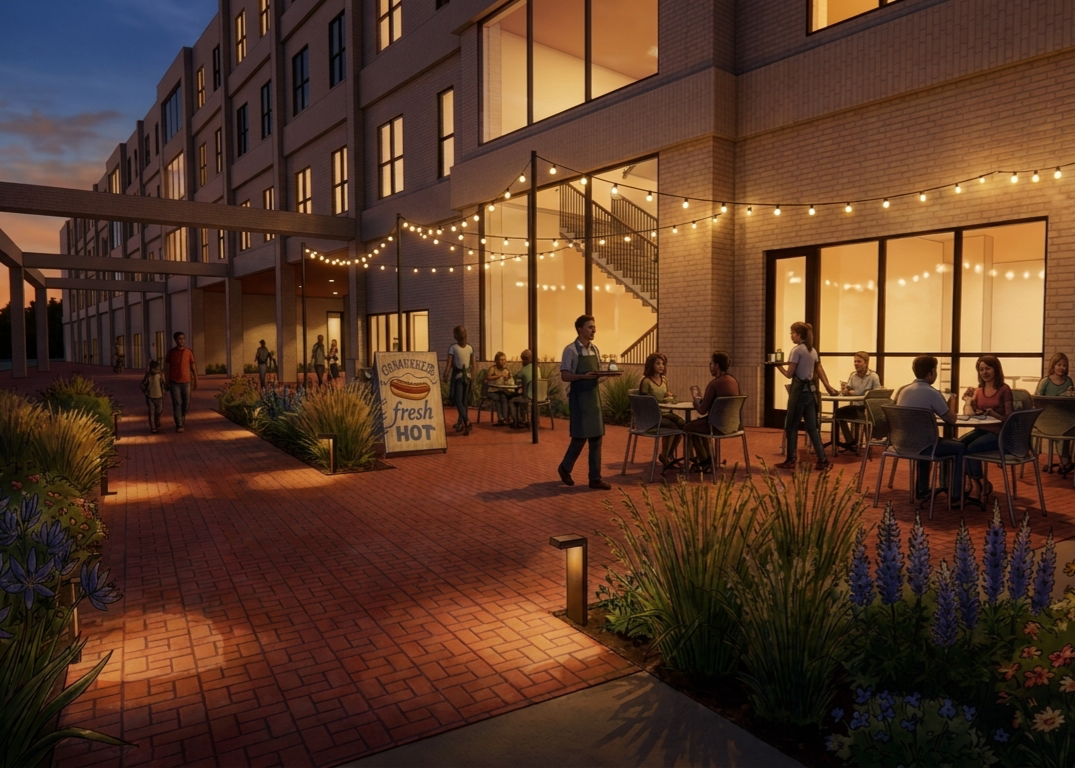
SE 17th Avenue Cafe at Twilight
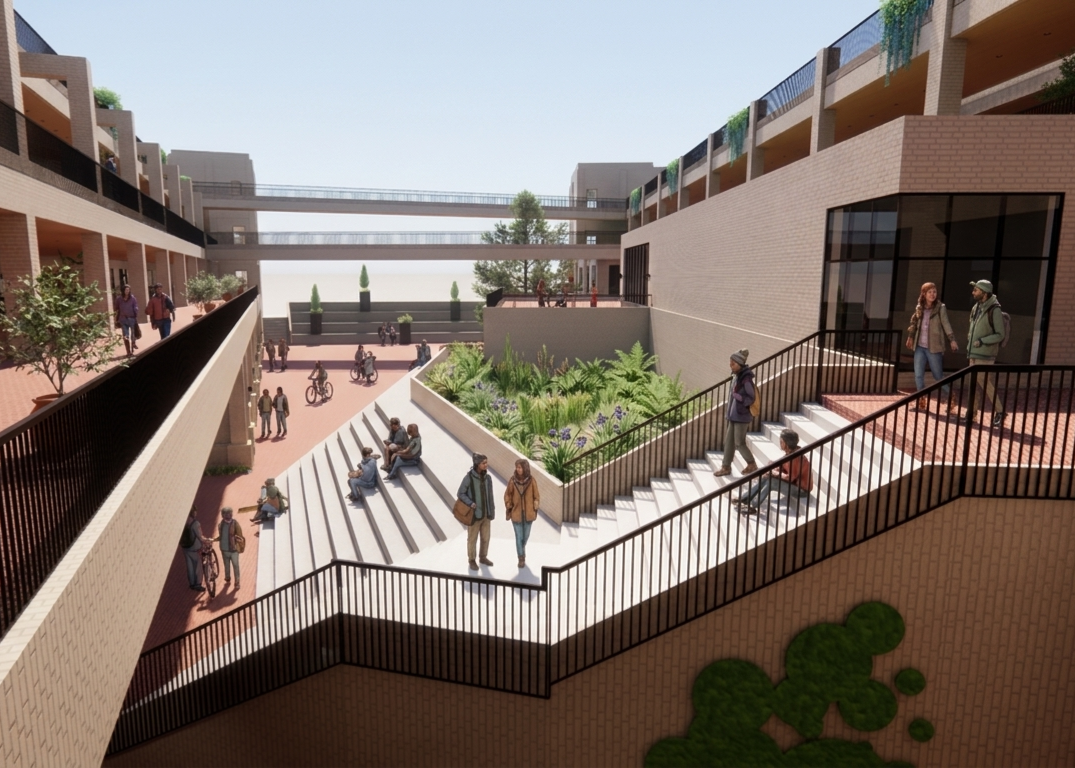
Interior Courtyard overlooking Rainwater Collection System
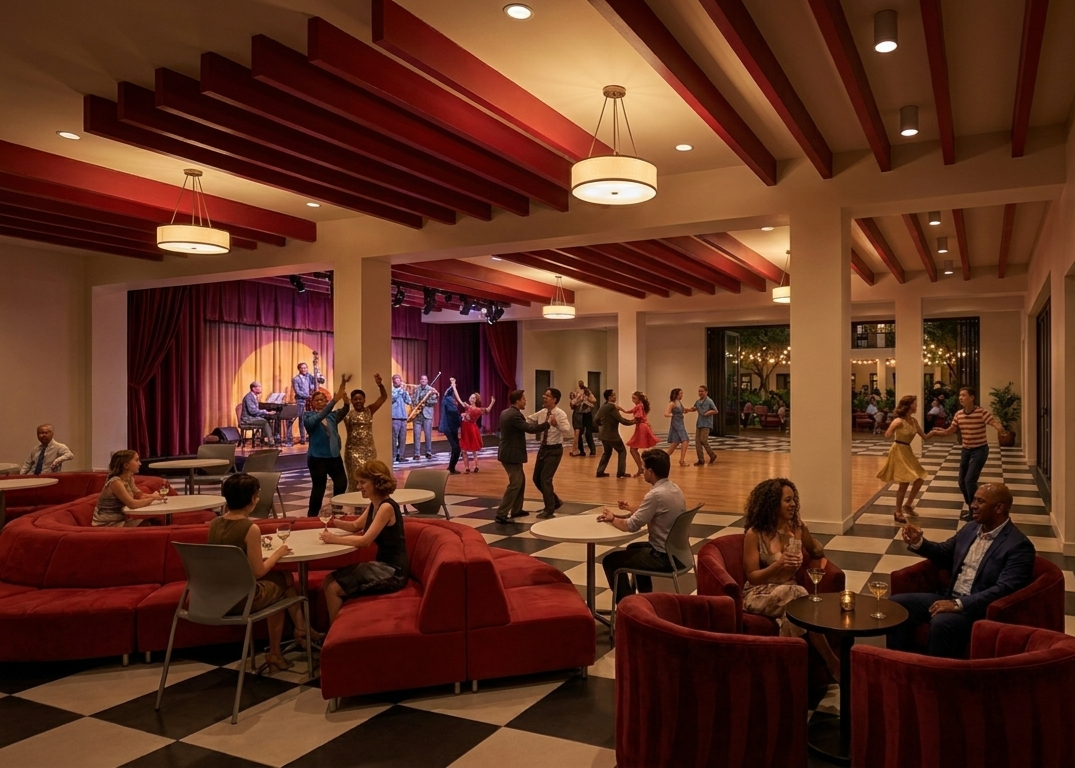
Brooklyn Dance Hall
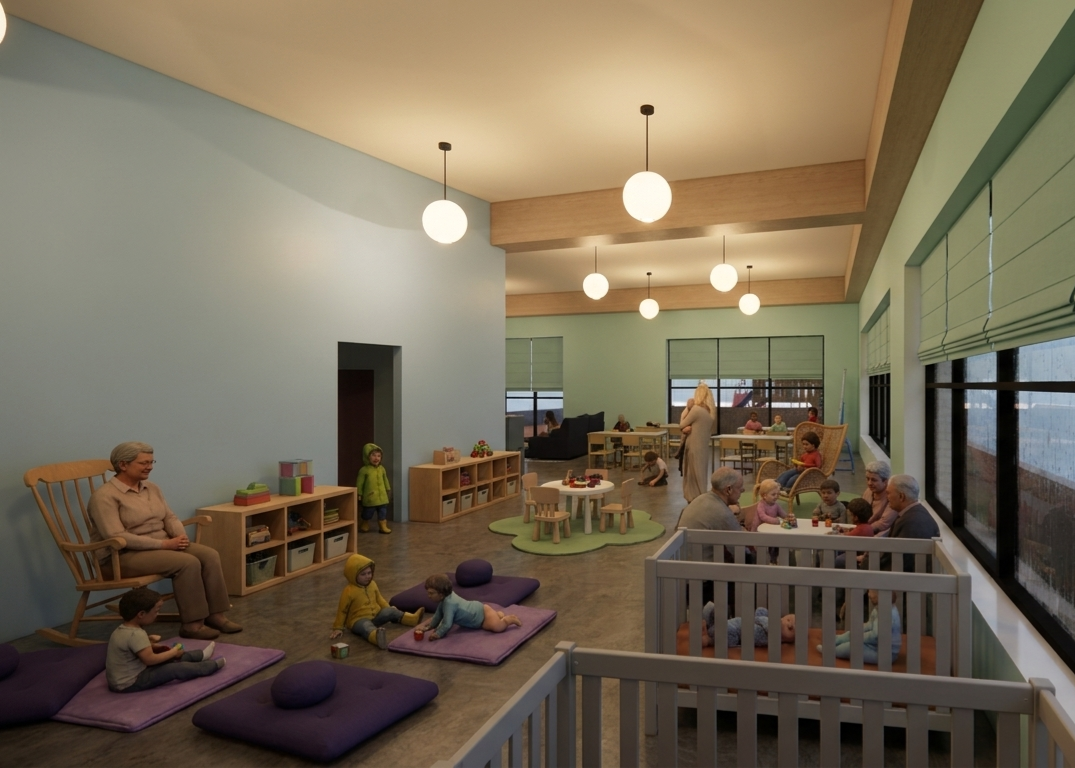
Mutual Aid Daycare
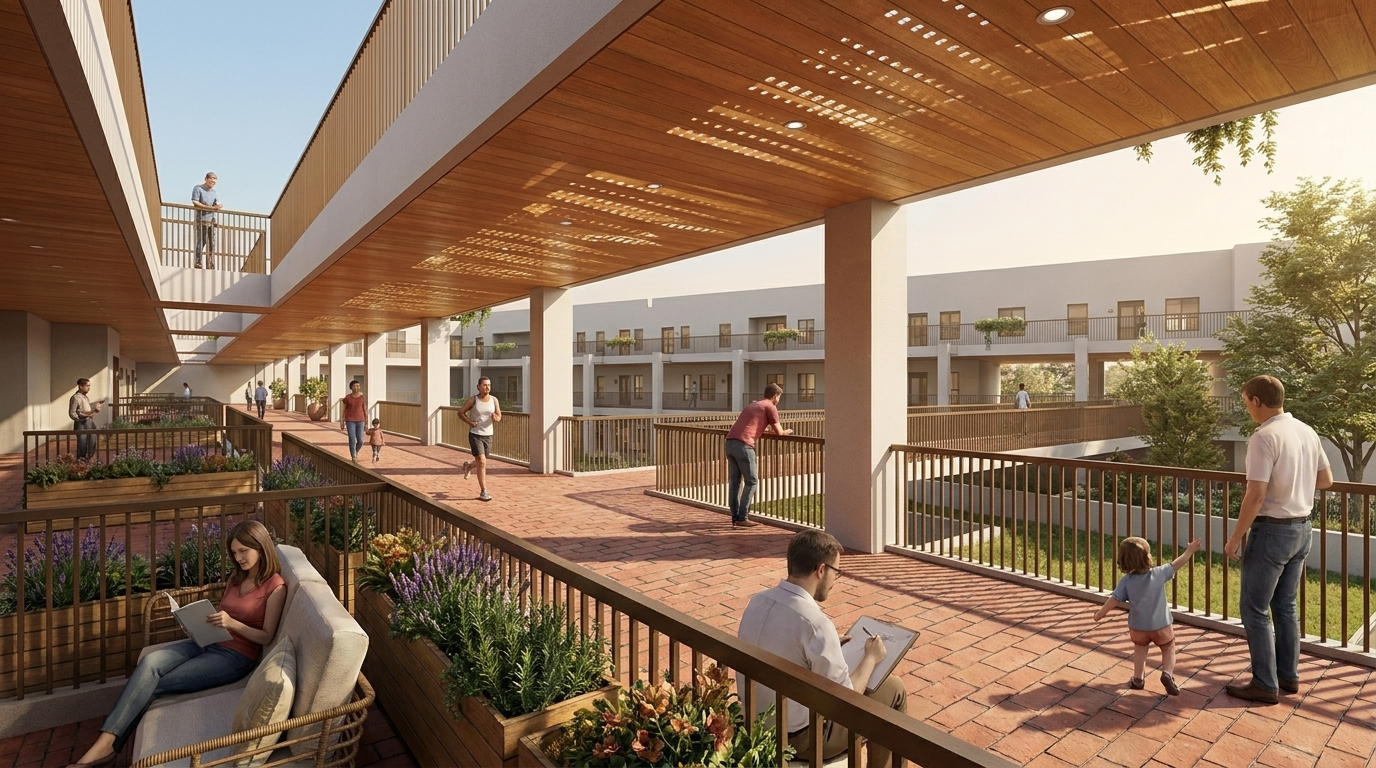
View from Floor 3 Residential Decks
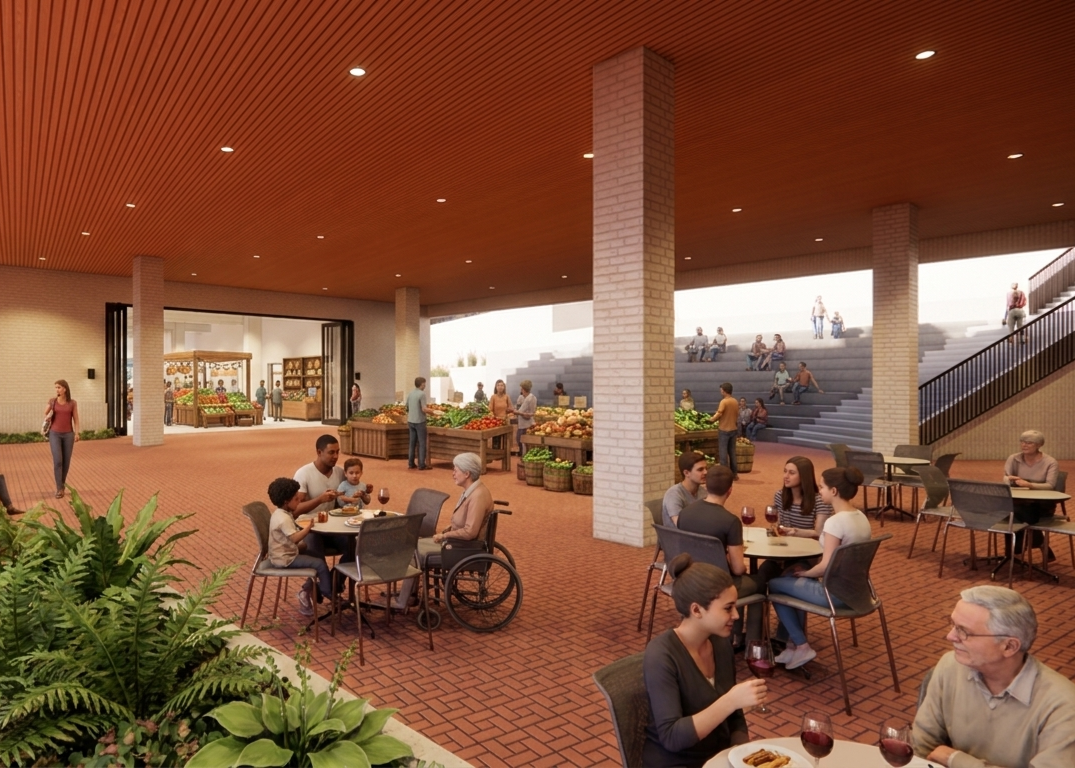
Public Market Entrance View
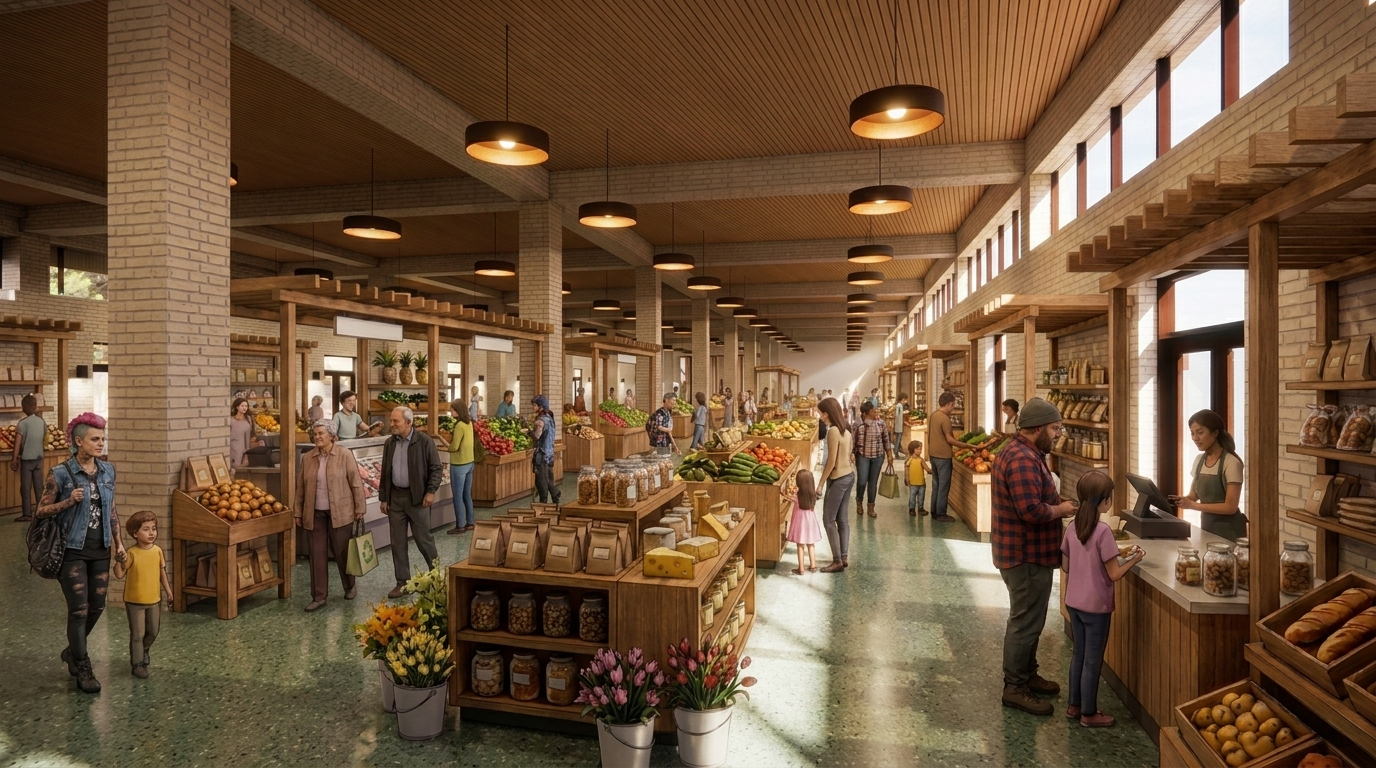
Interior view of Public Market
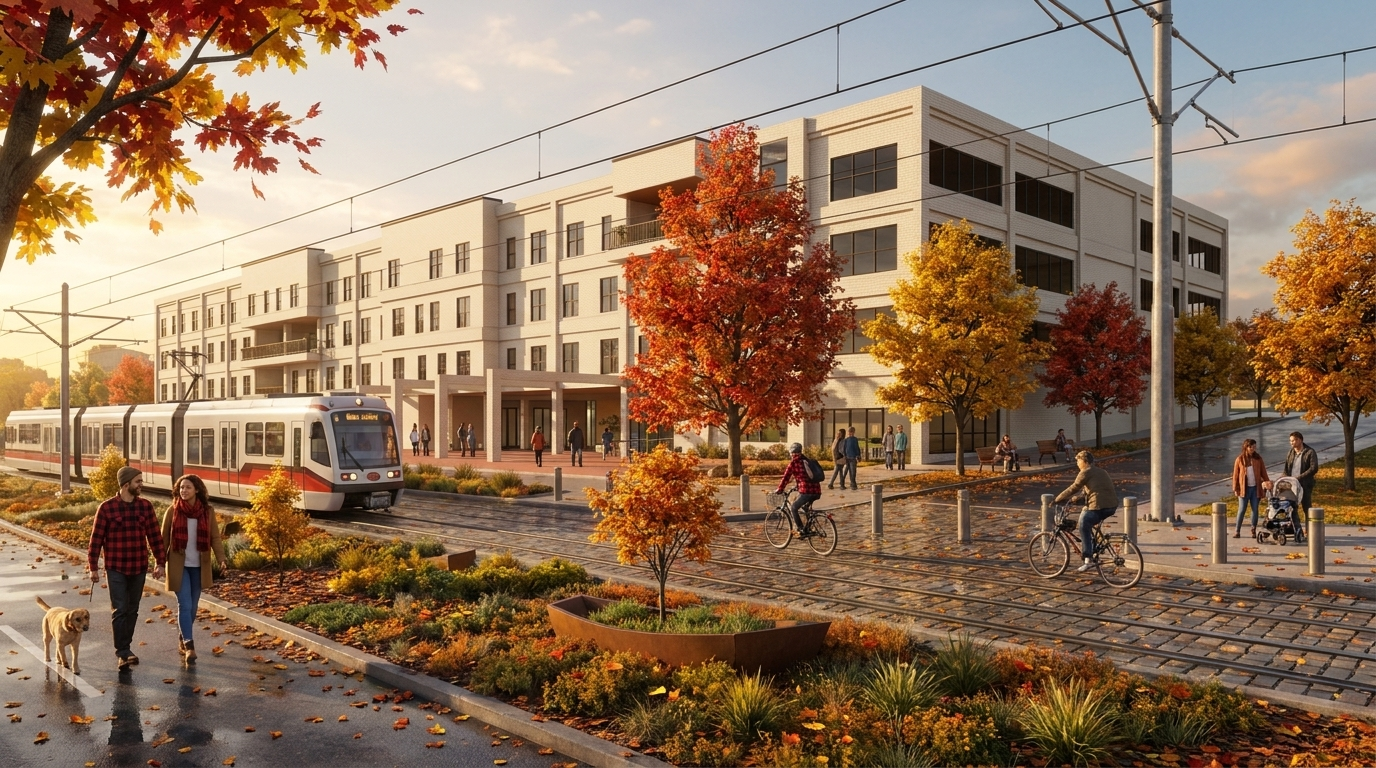
Perspective showing the building from SE 17th Avenue looking South
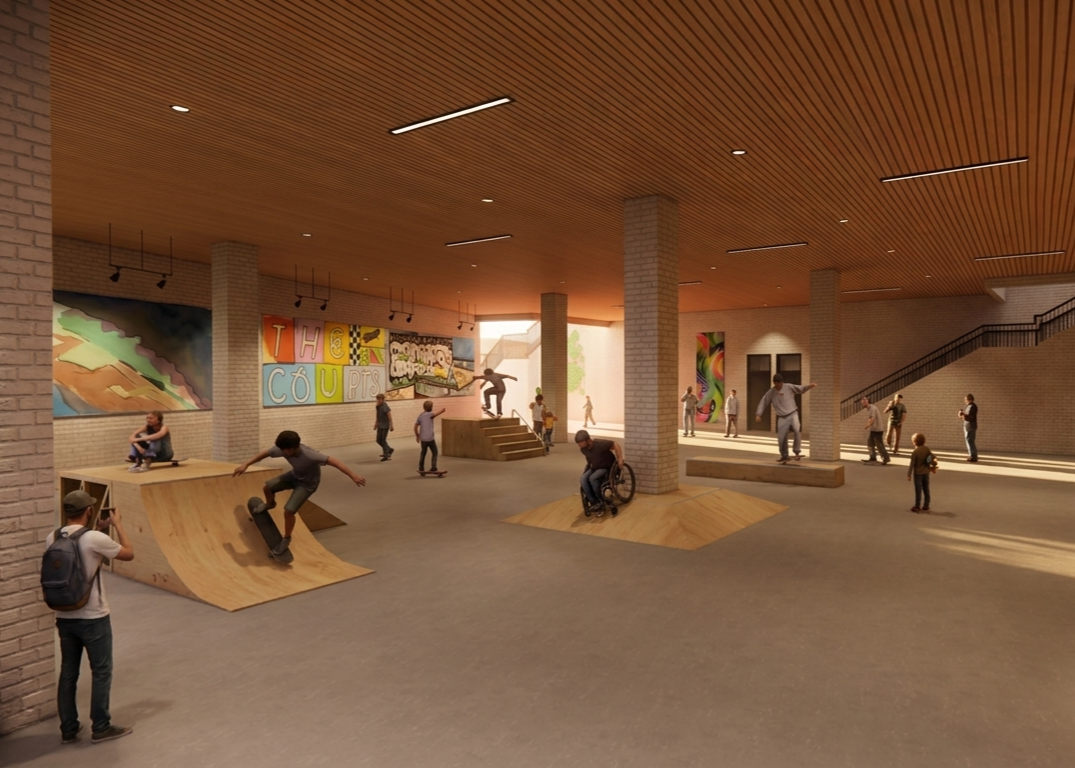
Community skate park

Thrift store at retail level on SE Schiller Street
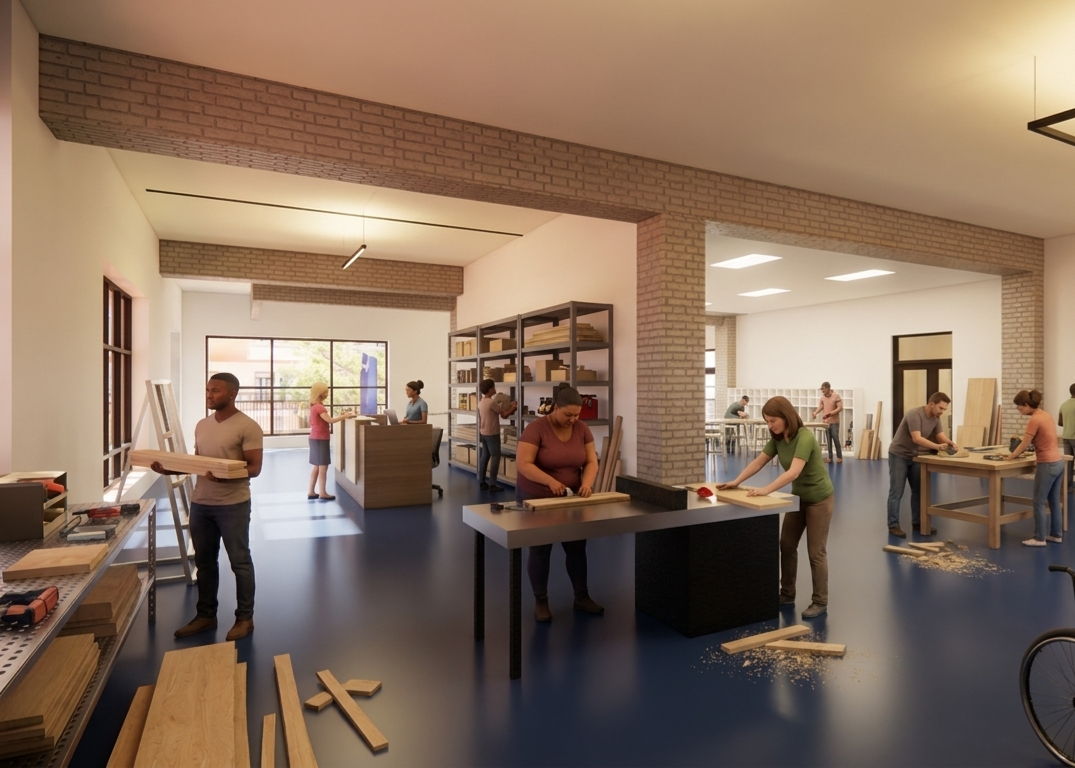
Community workshop on Second Floor
Subversion 02 · Design
Stack what conventional zoning separates.
Public programming and public housing are typically segregated by typology, by financing, and by ownership. The proposal at SE 17th + SE Schiller fuses them into a single four-story building, joined by a circulation system staged as social fascia: a connective tissue that holds tenant and visitor in the same fabric.
A working note
Subversion 02’s instrument is in development.
The thesis’ first subversion (Funding) and third (Practice) are released as operative instruments — a diagnostic spreadsheet and an organizing roster, respectively. The second subversion’s instrument — a generative design tool that consumes a Triage diagnosis and produces typological options — is forthcoming. What this page publishes now is the worked outcome at SE 17th + SE Schiller, and the sibling housing-scale framework that constrains it.
The proposed building
SE 17th + SE Schiller — a four-story program of mutual support.
The Brooklyn Action Committee identified the parcel; the diagnostic determined the program. Two floors of public programming carry two floors of public housing. The two stacks are not parallel circuits; they are joined by a single circulation system that residents and visitors share. The building’s argument is that the people who live in a building and the people who use a building should not be architecturally segregated.
Floor 04
Public Housing
Permanently affordable units; resident governance through the Brooklyn Commonwealth tenure structure. Designed for aging-in-place, multigenerational households, and accessible-by-default circulation. Roof terrace doubles as cooling refuge.
Floor 03
Public Housing
Mixed unit sizes. Shared laundry, kitchen, and a deck overlooking the market hall below. The vertical connection to the public floors is through the social fascia, not a service core.
Floor 02
Public Programming
Co-located primary care, behavioral health, and WIC. Adult-literacy and early-childhood drop-in. Indoor community hall. Mutual-aid storage and staging adjacent to the loading bay.
Floor 01
Public Market & Threshold
Vendors selling low-cost gleaned produce, locally raised meats and seafood, cheese, and the staples Brooklyn lost when Safeway closed. ID-free cooling and warming refuge. Open to the street; legible from the sidewalk.
The connecting tissue
Social fascia.
In anatomy, fascia is the connective tissue that holds organs in spatial relation. In this building, the social fascia is the circulation system — stairs, decks, shared rooms, the threshold to the street — that binds public programming to public housing through mutual-aid networks. It is intentionally not a back-of-house corridor: laundry overlooks the market, the housing entry passes through the community hall, the roof terrace shelters the cooling center. The fascia stages the building’s political claim — that the architectural separation of resident from visitor is not technical but ideological — in physical material.
Why this stack
The diagnosis writes the building.
Each floor traces back to specific indicators in the Brooklyn assessment.
- The market floor answers Food Systems = 1.50 (Critical). It pulls displaced food dollars back into the neighborhood by hosting vendors that a conventional grocery’s rent excludes: gleaning networks, mutual-aid butchers, small-scale cheese and seafood producers. The market is the building’s economic engine and its public threshold simultaneously.
- The public-programming floor answers Healthcare (2.00) and the Education and Social-Community gaps in a single trip. It reduces the trip-cost that Mobility = 2.33 makes punishing for the populations the Shadow Data names: the homebound elderly, the formerly incarcerated, the gig worker.
- The two housing floors answer Built Environment (2.33) and Economic Agency (2.00) directly. Permanently affordable units, owned by residents through a Community Investment Trust, withdraw the parcel from the speculative market that the Orange Line is currently inflating.
- The social fascia answers what no single indicator can name: the assessment’s deepest finding — that Brooklyn’s strengths are community-produced while its deficits are capital-produced. The fascia gives the community-produced work a building.
Sibling instrument
Right-Sizing Density — zoning capacity is not social capacity.
A neighborhood capacity-and-care framework that governs the housing floors specifically. Where Triage answers what program, Density answers how much, in what mix, and with what shared infrastructure. The toolkit pairs with Triage on every housing project.
The framework
Inputs → Filters → Design Responses.
Three stages, each governed by a hard rule. The toolkit is read across — no single input metric decides anything alone.
Stage 1
Inputs
Five overlapping clusters of evidence:
- Demographic pressure — aging populations, disability, length of stay, household composition
- Housing stress + extraction risk — rent burden, loss of affordable units, ownership patterns
- Care infrastructure — childcare, eldercare supply, care labor, schools, clinics
- Migration + future shocks — climate, political refuge, eviction trends, temporary housing
- Intergenerational overlap + ownership — CLT or co-op presence, financing and governance feasibility
Toolkit rule: Inputs describe pressure, absence, and volatility — not targets.
Stage 2
Filters
Three interpretive questions read across the inputs:
- Pressure — what is strained?
- Absence — who is missing?
- Volatility — what will change?
Toolkit rule: If a population is absent from data, treat the absence as evidence of exclusion.
Stage 3
Design responses
Four design levers, governed by the filter outcomes:
- Scale — under-build relative to zoning when extraction risk is high
- Unit mix — intergenerational, family- or migration-ready, flexible small units (not micro-units)
- Shared space — common room, care-ready flex, courtyard, cooperative kitchen and laundry
- Privacy rules — non-negotiable
Toolkit rule: If privacy and dignity cannot be met, reduce density.
Non-negotiables
Three privacy rules.
Privacy and dignity are the lower bound on density. If a development cannot satisfy all three, the response is to build fewer units.
No shared bathrooms across generations.
Co-living typologies that mix unrelated adults of different ages with shared sanitary facilities fail this test. Within a single household, shared bathrooms are fine; across households they are not.
Multiple thresholds between public and private.
A door directly off a corridor is a single threshold. The unit requires at least one more — a vestibule, a generous landing, a private walkway — so the transition from collective space to private is gradual and controllable.
Choice-based interaction only.
Communal life is offered, never compelled. Residents must be able to receive deliveries, do laundry, and access their unit without crossing programmed common space. Shared rooms exist alongside private circulation, never in place of it.
Anchor statement
Zoning capacity does not equal social capacity.
Right-sizing housing requires designing for care, privacy, and future change. The toolkit is intended for application across Portland neighborhoods, producing context-specific housing scales that resist displacement, institutionalization, and speculative extraction.
Onward
From form to labor.
The building’s program is sized; its housing is right-scaled. The third subversion turns to the labor that produces buildings at all — and the conditions under which any of this is materially possible.