From Old to Gold
We are at a moment in history when we can redefine public space after the COVID-19 pandemic. Young people are no longer flocking to restaurants and cafes opting instead for digital spaces because of systemic financial oppression. This notion led me to rethink a dying mall in NE Portland, Oregon. I began thinking of a new model for funding affordable housing in an undergraduate design studio in 2019. It seems that the perpetual conundrum of housing affordability is finding the funds to make projects happen. This is where the idea of pairing affordable housing with a public market comes into play.
To gain more insight if this would be possible I studied the history of public markets with a focus on Pike Place Market in Seattle, Washington. I came to learn that public markets not only provide opportunities for tourism but do much more for the communities they serve. Pike Place Market houses over 500 residents of mixed-incomes, an elder care facility, a daycare, a social services office, and a free health clinic. I studied the mechanisms that made Pike Place happen to learn that a local architect, Victor Steinbrueck, worked with the local government to preserve the market in the 1970s. The market’s origins began in 1907 when citizens of Seattle were facing inflated prices on foods, and farmers resisted inflation by selling directly to consumers at the market. Today, the Seattle landmark brings in a steady stream of income for the city and continues to support a diverse group of citizens.
During the summer of 2021, there was a stir in Portland, Oregon about the last anchor tenant of the Lloyd Center Mall pulling out. This left all the large retail stores vacant in the once-popular mall. The City of Portland has worked the mid-century mall into a number of city planning efforts over the years, but despite all of the support the mall has lost the support of the people over and over again. To redevelop a shopping mall in the same spot is a mistake proven twice by previous owners.
Following Steinbrueck’s methodology, I presented the idea to the City Council of Portland and drafted a proposal with a student group at Portland State University. The proposal outlines a new typology of a public mall that earmarks funds of revenue to be used for affordable housing initiatives within the Portland metro area. The public mall includes industries beyond just food and art as a traditional public market would allow which creates space for a small business incubator in the city. This creates affordable access to business ownership for a diverse range of citizens including those who are financially barred from business ownership. The public mall would be a public-private partnership between the owners of the mall, the city, and the county government. Furthermore, the space could act as a resilience hub for the community to come together after a catastrophic event like an earthquake or wildfire.
The City of Portland city council meeting where Nathalie Hutchinson provided testimony about integrating a public mall.
The idea being well-received by Ted Wheeler and JoAnn Hardesty gave me hope that the project could have a positive impact on my community. I continued to develop the idea and found support from mentors at SERA Architects. Principals Becky Epstein and Tim Smith supported my efforts by connecting me to Keith Jones, CEO of Friends of the GreenLoop. Support from Becky Epstein also led to finding unique ways to fund the project by leveraging programs set fourth by the local utility companies.
Today, I am preparing to present the idea to the new owners of Lloyd Center Mall as well as the neighborhood association, and plan to bring the contract with me to my next firm. I am excited to see the community members of Portland making the spaces at Lloyd Center Mall their own by leasing the spaces for local business.
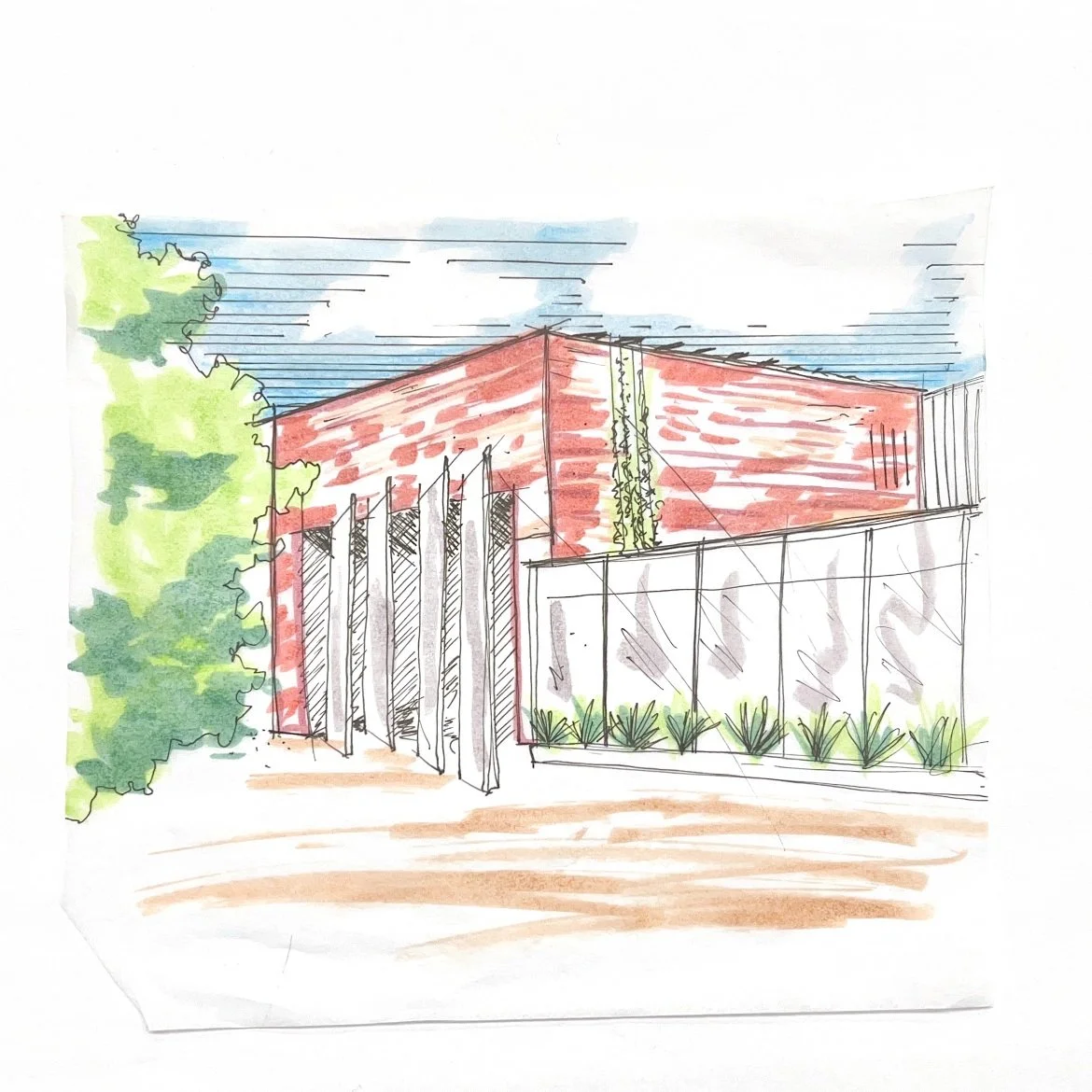
Hand drawing by Nathalie Hutchinson about an adaptive reuse idea for Lloyd Center Mall located in Portland, Oregon